

DIN 75201 Explained: A Guide for Automotive Test Laboratories
As automotive interiors continue to evolve with new polymers, adhesives, coatings, and sustainable materials, manufacturers face an ongoing challenge: ensuring these materials do not release excessive volatile compounds that can condense on interior glass surfaces.
To address this concern, automotive manufacturers have adopted standardized fogging tests to evaluate the emission of condensable volatile organic compounds (VOCs). Among these methods, DIN 75201 has become one of the most widely recognized and influential standards in the automotive industry.
Whether you are establishing a new laboratory, qualifying materials for an OEM program, or selecting fogging test equipment, understanding DIN 75201 is essential.
This guide explains the purpose of the standard, how the test is performed, what the results mean, and why repeatable laboratory equipment is critical for obtaining reliable measurements.
What Is DIN 75201?
DIN 75201 is a German industrial standard developed to evaluate the fogging characteristics of automotive interior materials.
Its primary purpose is to measure the tendency of materials to release volatile compounds that condense on cooler surfaces under elevated temperatures.
Although originally developed in Germany, DIN 75201 has become the foundation for many European automotive material specifications and is recognized throughout the global automotive industry.
Many manufacturers—including European OEMs and international suppliers—either reference DIN 75201 directly or incorporate its procedures into their own proprietary material standards.
Why Was DIN 75201 Developed?
Automotive interiors contain hundreds of individual components made from polymers, elastomers, foams, textiles, adhesives, and coatings.
Even when these materials meet mechanical and chemical performance requirements, they may still release small quantities of volatile substances during service.
When a parked vehicle sits in direct sunlight, cabin temperatures commonly exceed 80°C (176°F). At these elevated temperatures:
- Plasticizers may migrate from flexible polymers.
- Residual solvents may evaporate.
- Processing oils can volatilize.
- Low molecular weight compounds may be released from plastics and adhesives.
These vapors circulate within the passenger compartment before condensing on cooler surfaces, particularly the windshield.
The resulting film can:
- Reduce driver visibility
- Create haze on interior glass
- Contribute to interior odor
- Reduce perceived vehicle quality
- Generate warranty claims
DIN 75201 provides a standardized method for evaluating this behavior before materials enter production.
Which Materials Are Tested?
Virtually every material used inside the passenger compartment may require fogging evaluation.
Common examples include:
- Instrument panel substrates
- Dashboard skins
- Door trim
- Seat foam
- Leather and synthetic leather
- Carpeting
- Headliners
- PVC components
- Polyurethane foam
- Wire insulation
- Rubber seals
- Adhesives
- Sealants
- Decorative films
- Coatings
- Paint systems
Testing may be performed on raw materials, finished components, or complete assemblies depending on OEM requirements.
The Basic Test Principle
DIN 75201 simulates what occurs inside a vehicle during prolonged exposure to elevated temperatures.
A material specimen is placed inside a sealed glass beaker.
The beaker is heated under carefully controlled conditions while a cooled glass plate or aluminum foil covers the opening.
As volatile compounds evaporate from the specimen, they rise within the enclosed chamber and condense onto the cooled surface.
Once the prescribed exposure period has ended, the condensed material is evaluated using one of two principal methods.
Although the procedure is conceptually simple, achieving consistent results depends on precise control of:
- Heating temperature
- Cooling temperature
- Exposure time
- Sample preparation
- Glassware geometry
- Equipment calibration
Two DIN 75201 Test Methods
One reason DIN 75201 is widely accepted is that it recognizes two complementary methods of evaluating condensate.
Method A — Gravimetric Evaluation
This method measures the mass of condensable material released by the specimen.
Following the test:
- The collection foil or glass plate is carefully removed.
- It is conditioned according to the standard.
- An analytical balance measures the increase in weight.
The measured mass represents the amount of condensable VOCs released during the test.
Gravimetric testing provides a direct quantitative measurement and is particularly useful for comparing formulations or monitoring manufacturing consistency.
Method B — Reflectometric Evaluation
Reflectometric testing focuses on the optical effect of the condensed material rather than its mass.
Instead of weighing the condensate, the laboratory measures how much the deposited film reduces the reflectivity of the glass surface.
Because windshield haze is primarily an optical phenomenon, reflectometric evaluation often provides an excellent indication of how visible the deposit may appear to a vehicle occupant.
Many OEMs specify reflectometric testing when optical clarity is the primary concern.
Why Repeatability Is So Important
Automotive material specifications frequently establish very narrow acceptance limits.
A difference of only a few milligrams—or a small change in reflectance—may determine whether a material passes or fails qualification.
For this reason, repeatability is one of the most important characteristics of any fogging laboratory.
Poor repeatability may result from:
- Uneven heating
- Inconsistent cooling
- Glassware dimensional variation
- Improper specimen preparation
- Analytical balance drift
- Contamination during handling
When different laboratories obtain significantly different results from the same material, qualification delays and costly retesting often follow.
High-quality laboratory equipment minimizes these variables and improves confidence in reported data.
Common Sources of Test Variation
Although DIN 75201 provides a standardized procedure, laboratories should remain aware of common sources of measurement uncertainty.
Sample Preparation
Improper cutting, thickness variation, or contamination can significantly influence VOC release.
Consistent preparation techniques are essential.
Temperature Control
Heating blocks should maintain stable temperatures throughout the test cycle.
Localized hot spots may artificially increase evaporation rates.
Cooling Plate Temperature
Small differences in cooling temperature affect condensation efficiency.
Reliable temperature regulation improves reproducibility.
Glassware Quality
Beakers and glass plates should conform to the dimensional requirements of the standard.
Scratched or contaminated glass may alter condensation characteristics.
Analytical Equipment
Balances and reflectometers should be routinely calibrated and verified according to laboratory quality procedures.
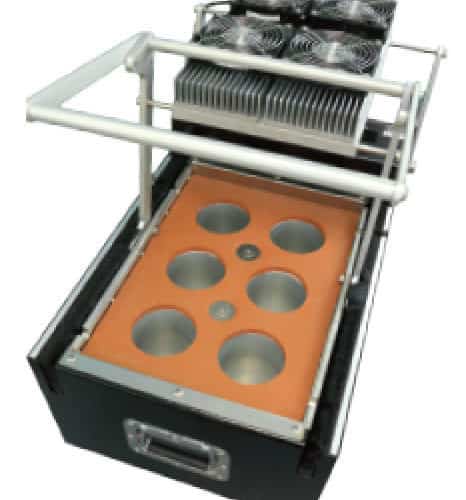
Schap Dry Fog Testing Systems
For more information about Schap Fog Testing Systems, view our products page or type “fog” in the search bar at the top of this page..
DIN 75201 and OEM Specifications
One common misconception is that passing DIN 75201 automatically satisfies every automotive manufacturer’s requirements.
In practice, most OEMs incorporate DIN 75201 into broader proprietary material specifications.
These specifications may include additional requirements such as:
- Material conditioning procedures
- Sample orientation
- Acceptance limits
- Statistical sampling plans
- Laboratory accreditation requirements
- Retesting procedures
Laboratories should always verify the exact specification referenced by the customer rather than relying solely on the published DIN standard.
Equipment Considerations for DIN 75201 Testing
When selecting fogging test equipment, laboratories should evaluate several critical performance characteristics.
Temperature Uniformity
Uniform heating across all test positions improves repeatability and reduces laboratory variation.
Multi-Sample Capability
Many production laboratories benefit from systems capable of testing multiple specimens simultaneously while maintaining identical conditions.
Calibration
Equipment should allow straightforward verification of heating temperatures, cooling temperatures, and timing functions.
Ease of Operation
User-friendly controls and ergonomic specimen handling reduce operator variability and improve laboratory efficiency.
Long-Term Reliability
Fogging systems are frequently operated for years in production laboratories. Durable construction and dependable temperature control minimize maintenance and downtime.
Best Practices for Successful DIN 75201 Testing
Laboratories can improve data quality by following several best practices:
- Develop standardized sample preparation procedures.
- Verify equipment calibration on a routine schedule.
- Maintain clean glassware and specimen handling practices.
- Document environmental conditions where applicable.
- Train operators using written work instructions.
- Participate in inter-laboratory comparison programs when available.
These practices not only improve measurement consistency but also support laboratory accreditation under ISO/IEC 17025.
DIN 75201 in a Changing Automotive Industry
Vehicle interiors continue to evolve as manufacturers introduce recycled polymers, renewable materials, lightweight composites, and bio-based plastics.
While these materials offer environmental benefits, they often require careful evaluation to ensure they meet increasingly demanding VOC emission requirements.
Electric vehicles have further increased the importance of interior quality. With quieter cabins and heightened consumer expectations, even minor odor or fogging issues become more noticeable to occupants.
Consequently, DIN 75201 remains a critical tool for evaluating new materials before they enter production.
Conclusion
DIN 75201 has become one of the most important standards for evaluating fogging behavior in automotive interior materials. By providing a repeatable method for measuring condensable VOC emissions, it helps suppliers and manufacturers identify potential problems long before a vehicle reaches the customer.
Successful implementation depends not only on following the published procedure but also on using well-designed laboratory equipment, maintaining rigorous quality practices, and understanding the specific requirements of individual OEM material specifications.
For laboratories committed to producing reliable, repeatable results, investment in precision fogging equipment and standardized testing procedures is an investment in product quality, customer satisfaction, and long-term success.
Continue Learning About Automotive Fog Testing
Want a broader understanding of how fogging tests fit into automotive material qualification?
Read our comprehensive guide:
Understanding Automotive VOC Fog Testing: Why Fogging Tests Are Essential for Automotive Interior Material Qualification
That article explores VOC sources, compares international standards, explains gravimetric and reflectometric methods in greater depth, and discusses how manufacturers can reduce fogging failures through improved material selection and process control.
About Schap Specialty Machine
Schap Specialty Machine designs and manufactures precision laboratory equipment for automotive materials testing. Our fogging test systems are engineered to provide accurate temperature control, repeatable performance, and long-term reliability to help OEMs, Tier 1 suppliers, and independent laboratories meet the demanding requirements of today’s automotive standards.
