
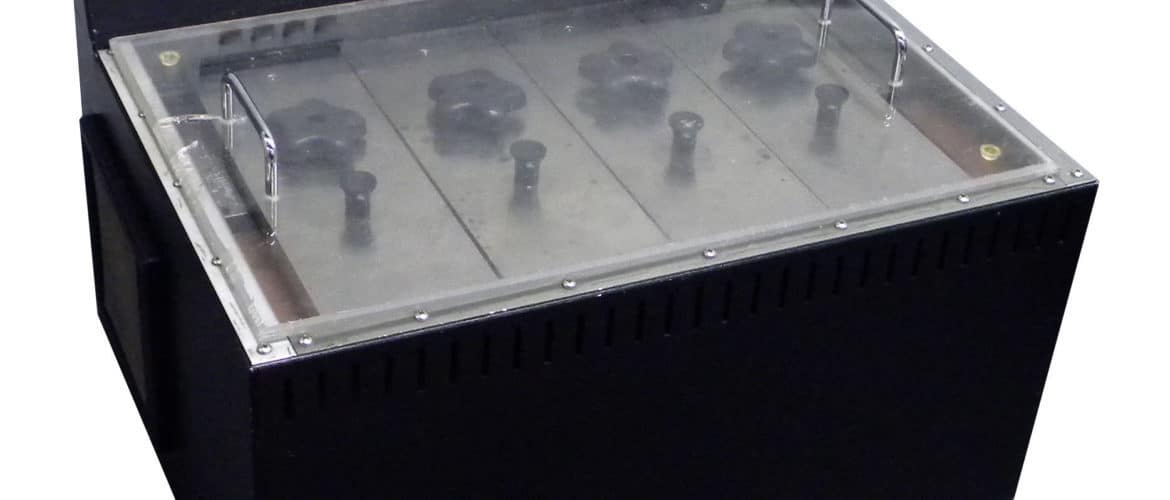
How Hart Scientific and Fluke Raised the Standard for Dry Fog Testing Equipment
The Evolution of Automotive Fogging Test Technology
Automotive interior fogging testing has become one of the most important material qualification procedures for modern vehicle manufacturers. As dashboards, instrument panels, adhesives, plastics, foams, textiles, and coatings are exposed to elevated temperatures, they release volatile organic compounds (VOCs) and semi-volatile organic compounds (SVOCs). These vapors condense on cooler surfaces such as windshields, reducing visibility and creating customer complaints.
Today’s testing procedures are well defined by standards such as DIN 75201, SAE J1756, ISO 6452, ISO 17071, PV 3015, GMW 3235, and numerous OEM specifications. However, producing repeatable and reproducible results has not always been easy.
One company played an important role in advancing the equipment used for these tests: Hart Scientific, later becoming part of Fluke Calibration.
The Early Challenges of Dry Fog Testing
The original DIN 75201 methodology was straightforward in concept:
- Heat the material specimen to approximately 100°C.
- Maintain the condensation surface at approximately 21°C.
- Allow volatile compounds to evaporate.
- Measure the resulting condensate by reflectometry or gravimetric analysis.
Although the procedure sounds simple, laboratories frequently experienced problems obtaining consistent results.
Common issues included:
- Temperature gradients inside the heating block
- Poor thermal stability
- Uneven cooling of the glass plate
- Inconsistent sample heating
- Difficult manual operation
- Long stabilization times
- Variations between laboratories
Since the amount of fogging is often very small, even slight temperature inconsistencies could significantly affect test results.
Hart Scientific Applied Metrology Principles
Hart Scientific was already recognized worldwide for producing precision temperature calibration equipment before entering the fogging equipment market. Following its acquisition by Fluke in 2001, that expertise became part of the Fluke Calibration organization. (ITWeb)
Rather than simply manufacturing another fogging tester, Hart Scientific approached the problem from a metrology perspective.
Their engineers focused on improving the variables that most affect repeatability:
- Temperature accuracy
- Temperature stability
- Uniform heat distribution
- Controlled cooling
- Repeatable operating procedures
These improvements reduced one of the largest sources of uncertainty in dry fog testing—the equipment itself.
Precision Temperature Control
Perhaps the greatest improvement introduced by Hart Scientific was significantly better temperature regulation.
Instead of allowing noticeable cycling around the desired setpoint, Hart systems utilized precision electronic controllers capable of maintaining extremely stable temperatures.
Stable heating means:
- More consistent VOC evaporation
- Less variation between tests
- Improved repeatability
- Better agreement between laboratories
This philosophy mirrored Hart Scientific’s work in high-accuracy calibration baths and dry-block calibrators, where temperature uniformity is the primary performance characteristic. (Fluke)
Improved Thermal Uniformity
Uniformity across every sample position is equally important.
If one specimen is heated even a few degrees differently than another, fogging results can vary despite identical materials.
Hart Scientific engineered heating systems that minimized:
- Horizontal temperature gradients
- Vertical temperature gradients
- Localized hot spots
- Uneven thermal transfer
This allowed multiple specimens to experience nearly identical thermal conditions throughout the test.
Better Cooling Control
The cooled glass plate is equally critical.
Condensation must occur under tightly controlled conditions because the measured fog layer depends on both evaporation and condensation.
Hart Scientific improved cooling performance by providing:
- Stable coolant temperature
- Better thermal contact
- Improved glass temperature uniformity
- Reduced temperature drift during testing
The result was more consistent condensate formation across every test.
Easier Standard Compliance
As automotive manufacturers introduced additional specifications based on DIN 75201, laboratories needed equipment capable of meeting multiple international standards.
Hart Scientific designed systems compatible with numerous testing methods, including:
- DIN 75201
- SAE J1756
- ISO 6452
- ISO 17071
- Various Volkswagen, GM, Ford, Stellantis, and other OEM procedures
This flexibility helped laboratories qualify a wider variety of automotive materials using a common testing platform. (Yumpu)
Improved Laboratory Productivity
Beyond measurement quality, Hart Scientific also focused on usability.
Earlier fogging equipment often required considerable operator attention.
Hart designs emphasized:
- Simplified controls
- Stable automated temperature regulation
- Faster stabilization
- Reduced operator adjustments
- Easier maintenance
These improvements reduced opportunities for operator-induced variability.
The Fluke Acquisition
In 2001, Fluke Corporation acquired Hart Scientific to expand its precision calibration portfolio. Hart Scientific continued developing temperature calibration technologies under the Fluke Calibration brand while maintaining its reputation for metrology-grade instruments. (ITWeb)
The acquisition strengthened Hart Scientific’s ability to support laboratories worldwide with:
- Global service
- Calibration support
- Expanded engineering resources
- Long-term product support
Why Repeatability Matters More Than Absolute Accuracy
One of the most important lessons from Hart Scientific’s work is that repeatability is often more valuable than absolute temperature accuracy.
If every test is performed under identical thermal conditions, laboratories can confidently compare materials, identify production changes, and satisfy customer specifications.
For automotive qualification testing, repeatability is the foundation of meaningful data.
This philosophy aligns with ISO/IEC 17025 laboratory practices, where controlling measurement uncertainty is essential for producing reliable, defensible results.
Continuing the Evolution
Today’s laboratories expect more than simply meeting the minimum requirements of DIN 75201.
Modern fogging equipment should provide:
- Excellent temperature stability
- Outstanding thermal uniformity
- Repeatable operation
- Ease of calibration
- Long-term reliability
- Compliance with multiple international standards
These are precisely the engineering principles Hart Scientific helped establish and that continue to influence high-quality fogging equipment today.
At Schap Specialty Machine, we share this philosophy. Our Dry Fog Testing Systems are engineered around repeatability, thermal stability, and robust laboratory performance because the value of a fogging test depends not only on meeting the standard but on producing results that laboratories can trust every time.
For manufacturers supplying materials to the automotive industry, investing in equipment designed for repeatable performance ultimately reduces uncertainty, improves confidence in material qualification, and helps ensure compliance with demanding OEM requirements.
References
- Fluke Calibration. Hart Scientific Temperature Calibration History and Product Information. (Fluke)
- Fluke Corporation. Acquisition of Hart Scientific (2001). (ITWeb)
- Thermo Fisher Scientific. Understanding a Fog Testing System. (Yumpu)
- NCSLI. Improvement Study on the Use of Dry-Well Calibrators (Fluke Hart Scientific). (NCSLI)
